Sophie Gonzales
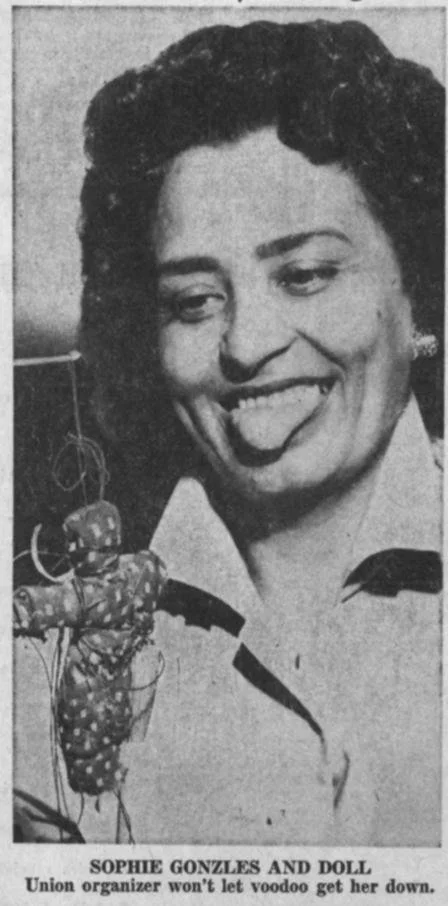
Sophie Gonzales with voodoo doll, in San Antonio Light, July 19, 1959. Article photo caption: Union organizer won't let voodoo get her down. Courtesy The University of Texas at Arlington Libraries, Special Collections.
“That trouble yesterday was started by the ‘scabs.’ My strikers acted only in self-defense. Sure we’re mad today. Wouldn’t you be if those people were screaming and cursing at you?”
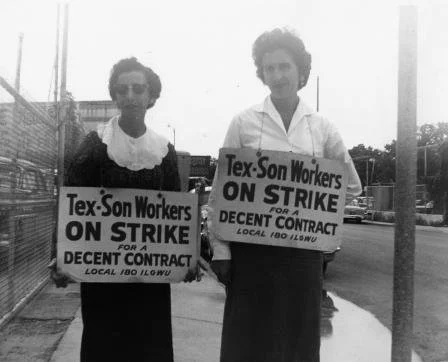
Two women on strike against Tex-Son. Photo courtesy of University of Texas at Arlington Libraries, Special Collections.
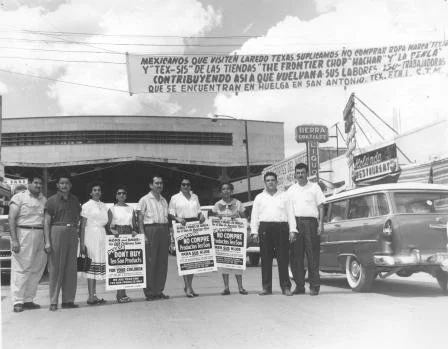
Picket line in Nuevo Laredo supporting the Tex-Son strike in San Antonio of the ILGWU [Sophie Gonzales is 4th from right], Photo courtesy of University of Texas at Arlington Libraries, Special Collections.
Leader of Tex-son Strike
1920–1995
Special thanks to Claudia Sánchez for writing this profile.
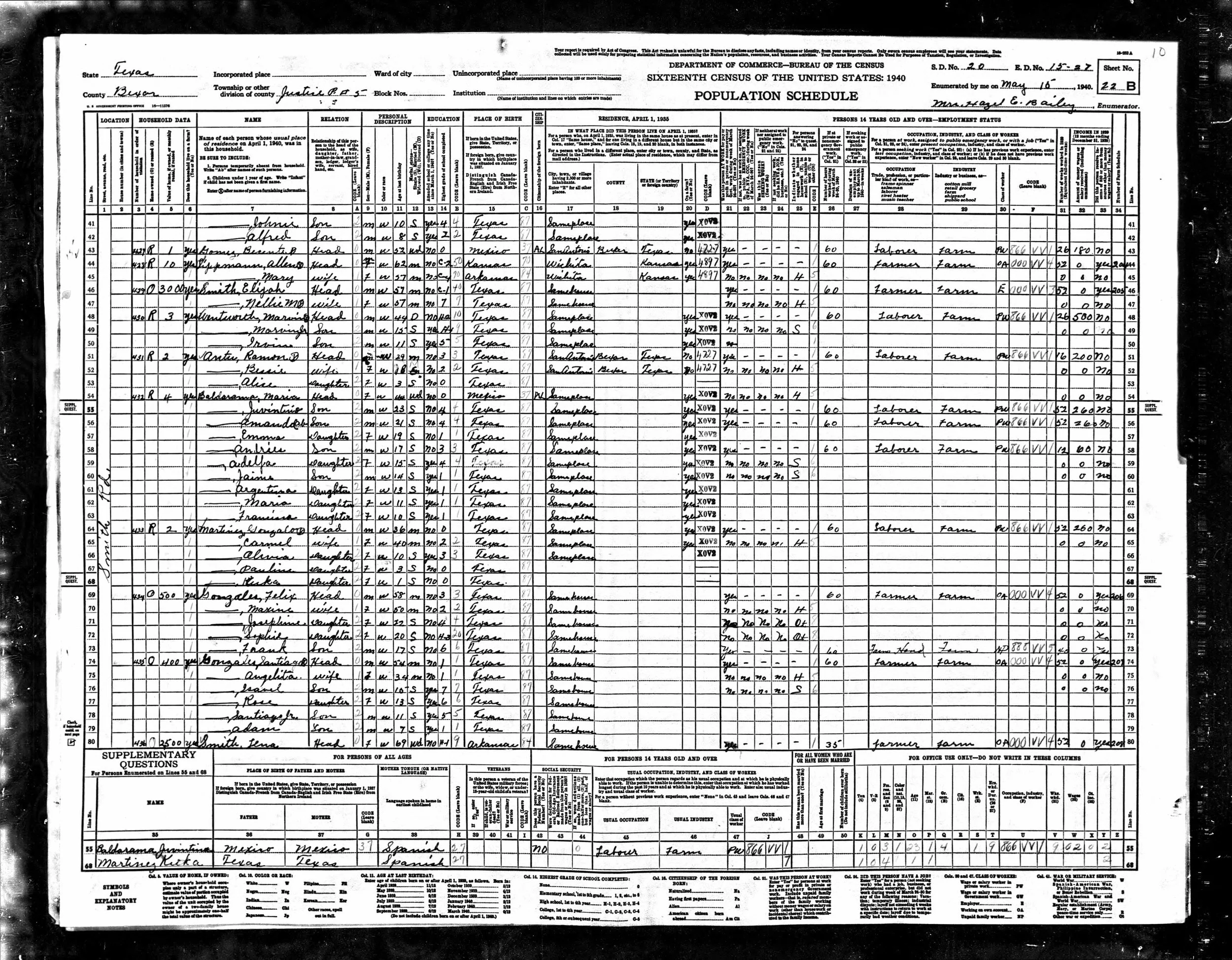
Sophie Gonzales, later to be known for her quick wit and charismatic leadership during the Tex-Son garment strike, was born on January 30,1920 in San Antonio, Texas to Feliciano and Maximiana (Reyes) Gonzales with one sister and two brothers.
She grew up in a very small town just southwest of San Antonio on a ranch in Von Ormy, Texas. From her home she would travel and attend the schools in Somerset, a bigger city at the time that was on the outskirts of San Antonio. She attended high school up to the tenth grade and would participate in the school’s volleyball, track, and baseball teams. Little is known about the conditions of her upbringing in Von Ormy, but Sophie was ready to spring into the workforce after spending two more years in her hometown. Her older brother left and set toward San Antonio for work, and after her 18th birthday, she decided to join him and find work at a local sweater company. Once in San Antonio, her first-hand experience as a garment worker was beginning, and her ties to the Westside were getting established. She got married to her first husband George Edward Gray in 1941 at the age of 21 and had two sons with him: George, Jr. Gray and Daniel Gray. Daniel Gray would go on to serve in the Air Force. By 1945 the two would divorce, a few short years before Sophie’s work as a union leader.
Sophie spent the next three years, from 1946 to 1949, laboring in a sweater shipping company in San Antonio. Here she gained the majority of her work experience in the garment industry. Although young and new to the field, she began to learn the hardships and inequalities she and other garment workers were subjected to such as low wages and job insecurity due to company outsourcing. Her older brother, who had been living and working in San Antonio for longer than her, was a part of the Amalgamated Butchers of America Union along with her other brother as well. In 1949, Sophie was offered a position as an organizer in the International Ladies’ Garment Workers’ Union local chapter. Following her brother’s advice and personal experience in the industry, Sophie accepted the position as protest organizer and officially joined the International Ladies’ Garment Workers’ Union (ILGWU). Thus, her journey and legacy as the first Mexican- American woman hired by the ILGWU began.
Sophie was unlike others who had the role before her. She had ten years of experience in the industry, and Sophie had an advantage that other Anglo organizers before her did not have. She was a Mexican- American woman who spoke Spanish fluently and was one with the community she was organizing. Her experience in the industry allowed her to make connections and friendships that would aid her in acquiring the position and becoming a successful leader. The previous ILGWU organizers were only White males who did not speak Spanish and could not properly connect with the Westside community of San Antonio. In the 1930’s the ILGWU had attempted to address this problem by sending White females who spoke Spanish to lead the organization. However, the relationship between these White organizers and Mexicana union members continued to be strained. This was exemplified by previous ILGWU organizer Rebecca Taylor who expressed her struggle to recruit and keep her Mexicana members due to the cultural differences and barriers between the two groups. Sophie was different from her Anglo predecessors. However, along with the positives of being the first Latina organizer she also had to tackle the difficulties her gender and race would play in her position. These would be shown in the Tex-Son garment workers strike of February 1959-1963; one of the first strikes in which Sophie held a significant leadership role. Tex-Son was a garment manufacturing company that sold children’s apparel in San Antonio, and their workforce was predominantly Hispanic women. The ILGWU local chapter 180 would form to protest against Tex-Son for better wages, an end to outsourcing, and increased job security for its workers.
In February 1959, less than one month into the strike against the Tex-Son Garment Manufacturing Company, Sophie was making headlines in the San Antonio Express as the leadorganizer of the strike. “Started As a Sweater Girl: S.A. Strikers Take Cues From Sophie, Organized Organizer,” read the article as reporter Marco Gilliam praised Sophie for her feminine and charismatic leadership style. Maintaining a physical appearance that was considered ladylike in the 1950’s atmosphere was of utmost importance for Sophie. As a Mexican American woman, the notion that she was “unladylike” because of her heritage was not a new tool others tried to use against her. Photos taken of the women after violent confrontations from police showcased the women with hair rustled and bare legs in order to paint the strikers as ‘promiscuous.' Sophie didn’t let critics use this tool to discredit the movement. Historian Lori A. Flores states: “Gonzales led the Tex-Son picket line every day in high heels, a conservative blouse, and a fashionably long skirt, modeling common understandings of proper 1950s womanhood for the press, police, and San Antonio public.” Due to this Sophie became a favorite of the press and her ability to make connections garnered a lot of attention to the movement. Her strikers followed suit and utilized the physical appearance of femininity as a weapon to discredit those who accused them of being violent and “unladylike” due to their ethnicity.
Along with this Sophie had to juggle the growing jealousy within her marriage due to her profession. In 1955 she married her second husband Tony Moreno and the marriage would last 15 years. Sophie revealed that her husband was very possessive and jealous. She would go on to say that “[He] started getting jealous because I [had] to work with a lot of men. . . . [O]ne day he just came up and he said, ‘Well it’s either me or your job.’” Moreno would go as far as to ask Sophie to drive more rather than sit in the passenger seat where she’d wave to other men on the street. This issue was one that many female union leaders face as a result of their work and one that Sophie was having to balance along with her responsibilities as a union leader.
Another notable feature of the movement was that it was the first labor strike in Texas in which Mexicana and Anglo women went on strike together. Although in 1959 Mexicanas made up 90% of the workforce at Tex-Son, most of the other workers were Anglo women facing the same issues of unfair wages, outsourcing for cheaper labor, and job insecurity. However, an issue the Anglo women did not have to face in the same way during the strike was the label of being “violent” and needing to be “contained” by police due to the supposed inherent violent nature of Latinas. Nevertheless, the two groups of women joined together and under Sophie’s leadership were able to form connections unseen before in any labor movement in Texas.
Sophie's excellence at breaking the norms surrounding her identity as a Latina led her to be a beloved leader. In one instance as rumors of the Tex-Son garment workers to be voodooists flew around due to their ethnicity, a glass bottle filled with a white substance and a small voodoo doll of Sophie fell at her feet. With her quick wit Sophie laughed and exclaimed “Voodoo is for the birds!” The press jumped at the story and Sophie’s ability to cleverly dismiss the attack landed the story in her favor.
“No tengas miedo -- don't be afraid.”-Sophie Gonzales
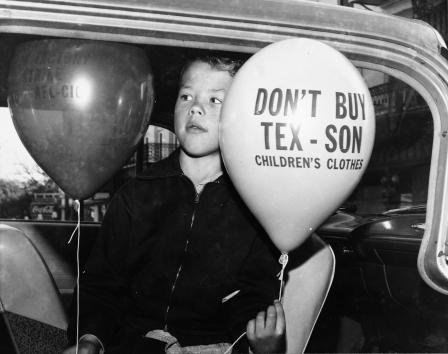
Other tactics she utilized during the strike was gaining the sympathy of mothers and their children to boycott the Tex-Son Manufacturing Company, who specialized in children's clothing. Children would be taken to the picket lines with signs of protest such as “Help Mama Help Me” and “Even a Kid knows it's Wrong to cross a picket Line.” This attention and support were soimmense the national ILGWU chapter and other unions around the country provided financial support for the workers. However, by late 1960 the national chapter began to suspect that the strike was going to be unsuccessful and pulled their funding. With the loss of funding the prospects for the strikers began to look dim. Tex-Son continued to outsource its employees and the strike continued. With no successes in sight, Sophie left the picket line in the fall of 1962 and headed toward El Paso, Texas. Shortly after she left the Tex-Son strike dissipated in the beginning of 1963. The Tex-Son company may have won the initial strike effects, but the boycott enacted by the strikers proved to be deadly as the company closed its doors due to bankruptcy and relocated to Dallas shortly after.
In El Paso, Sophie continued her labor union career and joined the Amalgamated Clothing Workers of America (ACWA) and the Federation of Union Representatives. After a few years of working as a member of these organizations she again led a strike in 1965 against the Hortex Manufacturing Company and another in 1971 against Levi-Strauss. Additionally, she aided in the Farah Clothing strike of 1972 before retiring in 1983. For her thirty-five years of unionist work in Texas she earned a plaque in her honor from the El Paso Joint Board of the ACWA.
Sophie Gonzales is remembered today for her contribution as the first Latina to lead a strike in ILGWU history and as a fighter against economic inequality for women no matter their race or ethnicity. Through her cool, calm, and collected demeanor Sophie exemplified an excellent leader dedicated to her cause.While Sophie herself did not reside in the historic Westside of San Antonio many of the people she was organizing and fighting for did. Although little is known about her upbringing and life after she retired, Sophie is forever commemorated for her bravery and persistence against labor exploitation. She passed away at the age of 74 on January 1st, 1995, in San Antonio, nearly 50 years since the first time she moved to San Antonio and began her journey as an activist.
Claudia Sánchez is a Public History major at St. Mary's University graduating in May 2022. Originally from the Bordertown Mcallen, Tx Claudia's background influenced her research interest in US Latinos and San Antonian history. She will be working toward her master's in Public History after graduation.
-
Flores, Lori A. “An Unladylike Strike, Fashionably Clothed: Mexicana and Anglo Women Garment Workers Against Tex-Son, 1959-1963.” Pacific Historical Review, Vol 78, No.3 (2009), pp. 367-402.
Ledesma, Irene. “Gonzáles, Sophie,” Handbook of Texas Online, accessed May 05, 2022, https://www.tshaonline.org/handbook/entries/gonzales-sophie.
Ledesma, Irene. “Unlikely strikers: Mexican-American women in strike activity in Texas, 1919-1974. Dissertation, Ohio State University, 1992.
Ledesma, Irene. Texas Newspapers and Chicana Workers’ Activism, 1919-1974. Western Historical Quarterly, Vol 26, No. 3 (1995), pp. 309-331.
Ruiz, Vicki L. From out of the Shadows: Mexican Women in Twentieth-Century America. Oxford: Oxford UP, 2008.
WBAP-TV (Television station : Fort Worth, Tex.). [News Script: Strike], item,February 27, 1959; University of North Texas Libraries, The Portal to Texas History, https://texashistory.unt.edu; crediting UNT Libraries Special Collections.