Jovita Idar
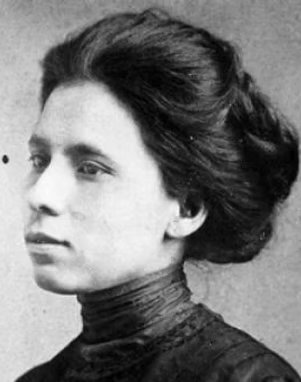
Portrait of Jovita Idár ca. 1905. General Photograph Collection, Courtesy the University of Texas at San Antonio Libraries Special Collections.
“Working women know their rights and proudly rise to face the struggle. The hour of their degradation has passed... They are no longer men’s servants but their equals, their partners.”
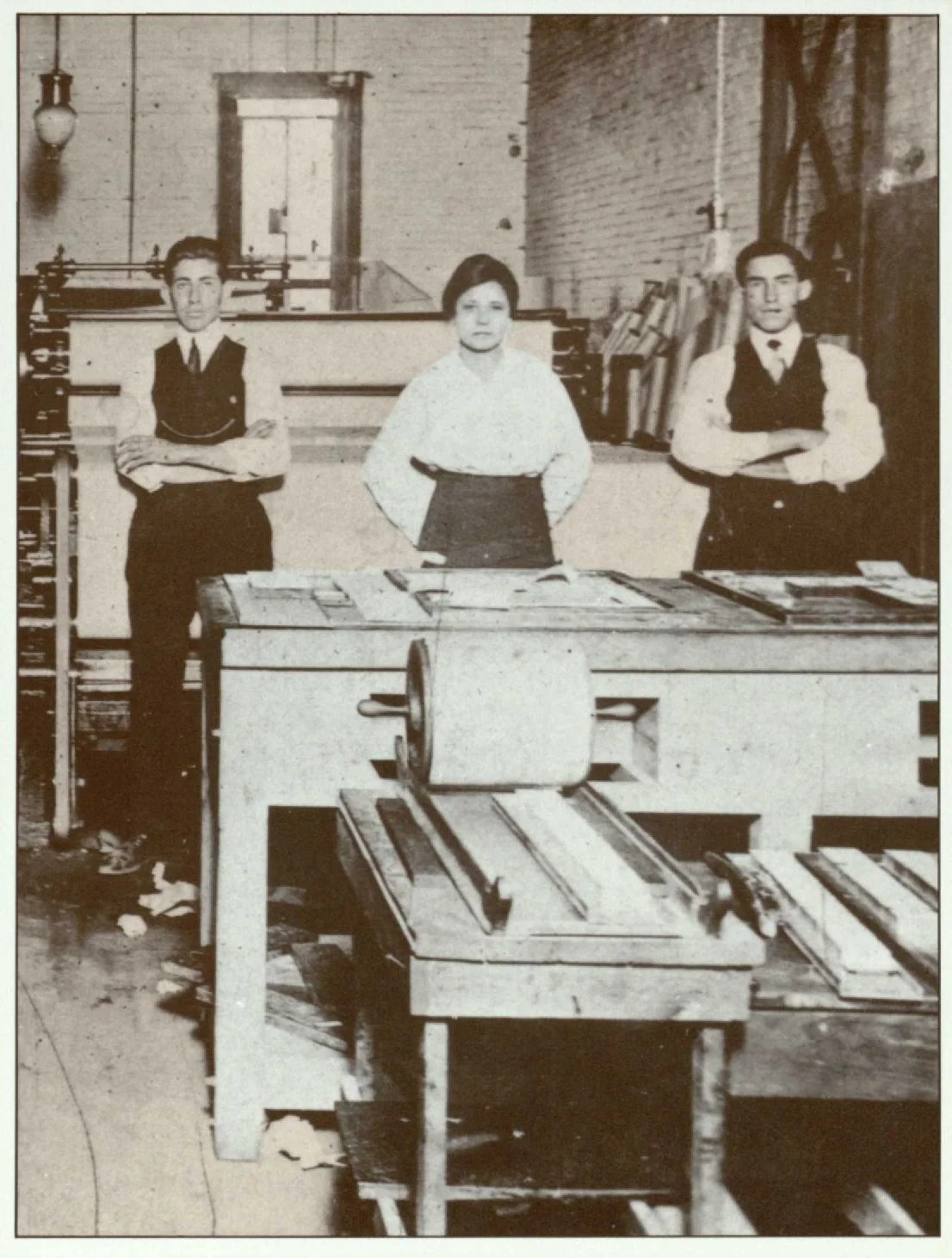
Jovita Idár at El Progeso newspaper, 1914 [postcard], Jovita Idár was a writer at El Progreso newspaper, Laredo, TX, 1914
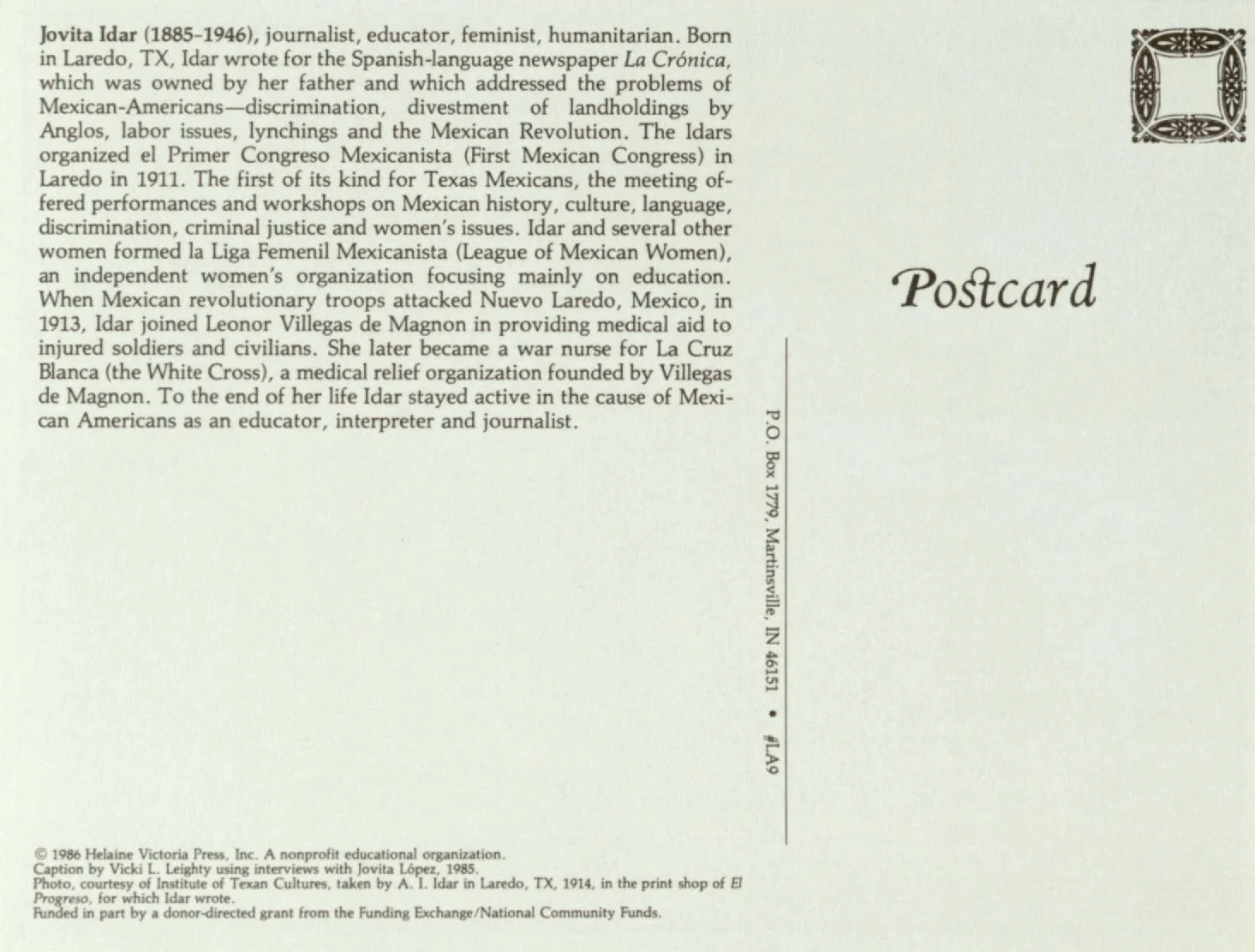
Jovita Idár at El Progeso newspaper, 1914 [postcard], Jovita Idár was a writer at El Progreso newspaper, Laredo, TX, 1914
Teacher, journalist and political activist
1885–1946
Teacher, journalist and political activist Jovita Idár praised women’s suffrage in her father’s weekly newspaper in Laredo, La Crónica, where she connected the vote to long standing demands for Mexican American civil rights. She was part of a family that spoke out against the educational and social discrimination that ethnic Mexicans faced in Texas. While she is most well known for her work in Laredo, she spent the last half of her life in San Antonio’s Westside, where she continued to advocate for women’s rights, civil rights, and provided education, food and clothing to her community.
Jovita Idár was born in Laredo in 1885. Her father, Nicasio Idar, was born in Port Isabel, Texas, and her mother Jovita Vivero was from San Luis Potosi, Mexico. They met on the border, married and had nine children. Nicasio worked as a yardmaster in the railroad yards of Nuevo Leon, where he organized workers in the city of Acambaro. According to his son Aquilino, in 1890 Nicasio formed the first union of railroad workers in Mexico, La Orden Suprema de Empleados Ferrocarrileros Mexicanos. Nicasio was able to leave railroad work and he eventually became publisher of the newspaper La Crónica in Laredo. The newspaper featured stories on the struggles of ethnic Mexicans, including educational and social discrimination, the loss of Mexican culture and the Spanish language, and lynchings. Three of his children– Clemente, Jovita and Eduardo, would continue to advocate for human and civil rights through journalism.
As a young girl, Jovita benefited from growing up in a middle class family with access to a good education. She attended the Laredo Seminary, where she learned English, and was also educated at the Domínguez Institute, where she was mentored by Professor Simón G. Domínguez. Jovita was trained as a teacher, earning her teaching certificate in 1903. She then taught in a small town called Los Ojuelos, in southwestern Webb County. She was angered by the lack of resources and poor classroom conditions, and also with the curriculum that did not educate Mexican children about their history and heritage. She also published a weekly bilingual educational magazine called El Estudiante.
Eventually Jovita resigned in order to become a journalist, where she felt she could encourage more social change. She began to work at La Crónica with her family. The family faced significant danger because of their activism. Jovita’s brother Federico was assassinated, and her brother Clemente received death threats. In spite of these challenges, the Idárs continued their social justice work. In 1911, after the brutal lynching of 14 year old Antonio Gómez in Thorndale Texas, her family organized El Primer Congreso Mexicanista, a conference to discussthe multiple grievances of ethnic Mexicans. This organization is credited with launching the Mexican American civil rights movement. Jovita helped create La Liga Femenil Mexicanista, an organization that advocated for women’s suffrage, provided food, clothing and education for poor children, and hosted literary and theatrical productions to raise money for the community. This league is one of the earliest known efforts of Mexican American women to unite for social and political causes. Jovita became the league’s first president. She consistently advocated for women’s rights.
In 1914, as the Mexican Revolution erupted in Nuevo Laredo, Jovita and her friend Leonor Villegas de Magnón joined a nursing unit, La Cruz Blanca. They smuggled wounded soldiers across the border for medical assistance. They also traveled into northern Mexico with revolutionary troops and established medical brigades. After her service, Jovita returned to journalism and joined the staff of El Progreso. She would sometimes write under two pseudonyms: A. V. Negra (Black Bird) or Astrea, the Greek goddess of justice. When the paper published an editorial protesting President Woodrow Wilson's dispatch of United States troops to the border, Texas Rangers arrived to close them down. Idár defiantly stood in front of them, daring them to knock her down. The Rangers left, but returned the next day, sacking the offices and smashing the printing press.
La Cronica shut down after Nicasio Idár’s death in 1914. Two years later, Idár started her own newspaper, Evolución. In 1917 she married Bartolo Juárez. Three years later they moved to San Antonio, and she transferred the operations of Evolución to her brother Eduardo. In San Antonio she worked as a translator for Spanish speaking patients at the Robert B. Green county hospital. She was also an English teacher and tutor. She taught immigrant communities to read and write, and helped undocumented workers obtain naturalization papers.
Jovita also became active in the Democratic Party, serving as a precinct judge, which was extremely rare for a Mexican American woman. She also established a free kindergarten. She continued writing as well, writing articles in Italian for La Voce de la Pattria, a San Antonio Italian language newspaper. She was particularly active as a member of La Trinidad Methodist Church. She served as conference president of the United Methodist Women and co-edited El Heraldo Cristiano, a publication of the Rio Grande Conference of the Methodist Church. While Jovita was always an advocate for women’s rights, her writing also reflected the concept of maternal Christian authority. Her articles in El Heraldo spoke to women of their special responsibility as Christian mothers, and put particular emphasis on a mother’s role in educating their children at home. Jovita Idár died in San Antonio in 1946, at the age of 61.
-
Cotera, Martha P. Diosa y Hembra: The History and Heritage of Chicanas in the U.S. Austin: Information Systems Development, 1976.
García, María-Cristina., "LIGA FEMENIL MEXICANISTA," Handbook of Texas Online. Accessed July 28, 2020. http://www.tshaonline.org/handbook/online/articles/vql01
González, Gabriela. Redeeming La Raza: Transborder Modernity, Race, Respectability, and Rights. Oxford: Oxford University Press, 2018.
González, Gabriela. “Jovita Idar: The Ideological Origins of a Transnational Advocate of La Raza,” in Texas Women: Their Histories, Their Lives, eds. Elizabeth Hayes Turner, Rebecca Sharpless, and Stephanie Cole. Athens: University of Georgia Press, 2015.
Jones, Nancy Baker. "IDAR, JOVITA," Handbook of Texas Online, Accessed July 16, 2020, http://www.tshaonline.org/handbook/online/articles/fid03
Limón, José E. "El Primer Congreso Mexicanista de 1911," Aztlán 5 (Spring, Fall 1974).
Morgan, Jack. “Historic San Antonio Woman's Activism To Be Showcased On PBS.”
Texas Public Radio, July 9, 2020 https://www.tpr.org/post/historic-san-antonio-womans-activism-be-showcased-pbs
Rogers, Mary Beth Rogers et al., We Can Fly: Stories of Katherine Stinson and Other Gutsy Texas Women. Austin: Texas Foundation for Women's Resources, 1983.
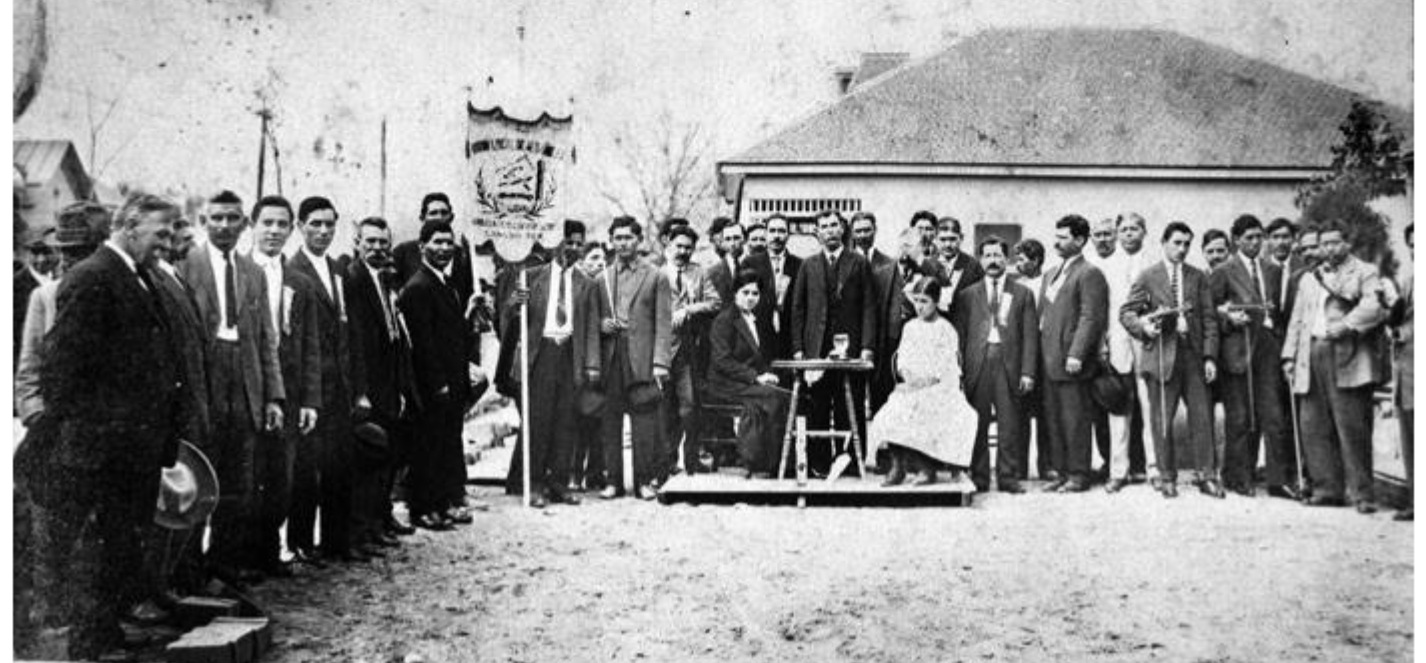
Jovita Idár and members of the Union of Stone Mason and Bricklayers, Laredo, Texas, ca. 1915, Jovita Idar and members of the Union of Stone Masons and Bricklayers (Union Local de Albaniles). On the platform are (I,. to r.): Jovita Idar, Professor simon Dominguez, and his daughter.