Beatrice Gallego
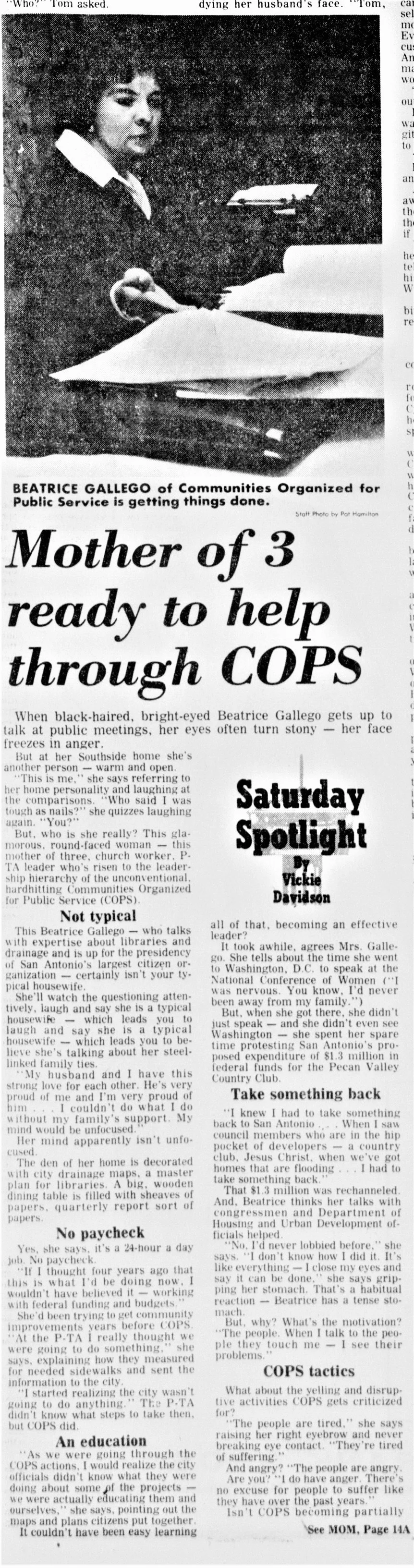
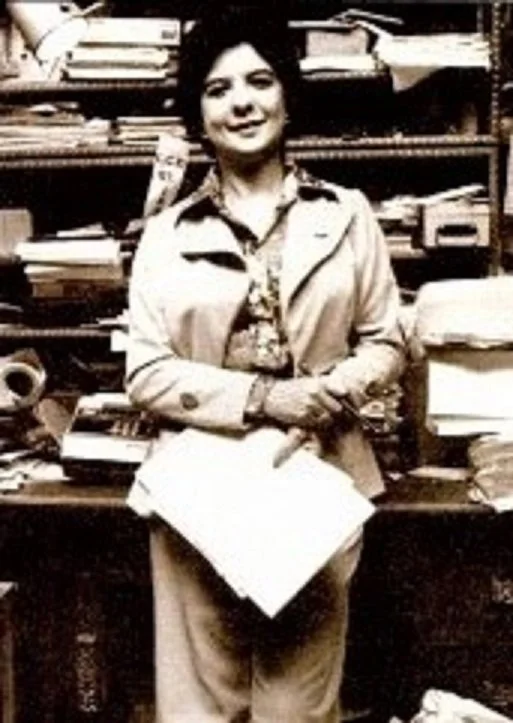
Beatrice pictured in the San Antonio Express-News in 1976. Staff photo by Pat Hamilton.
“Yes, severe rains drive hundreds of people from their homes each year, but beyond the miseries of the moment, the entire future of our community depends on basic capital improvement, adequate streets and drainage... These dollars are needed to build adequate housing and to attract quality business and jobs for our people. Without basic capital improvements our neighborhoods will slowly die and urgent needs and our people will go unmet, These needs of our people are many, housing to provide the space and privacy that families need to grow in security and dignity. Quality jobs and fair wages for their hard work.”
Community activist and COPS President
1934–present
Beatrice Gallego has spent her life advocating for the communities that San Antonio city leaders often neglect. As a parent volunteer, a devoted parishioner at St. James Catholic Church, and the second President of the Communities Organized for Public Service (COPS), Gallego has fought for Westside neighborhoods to get the resources they deserve.
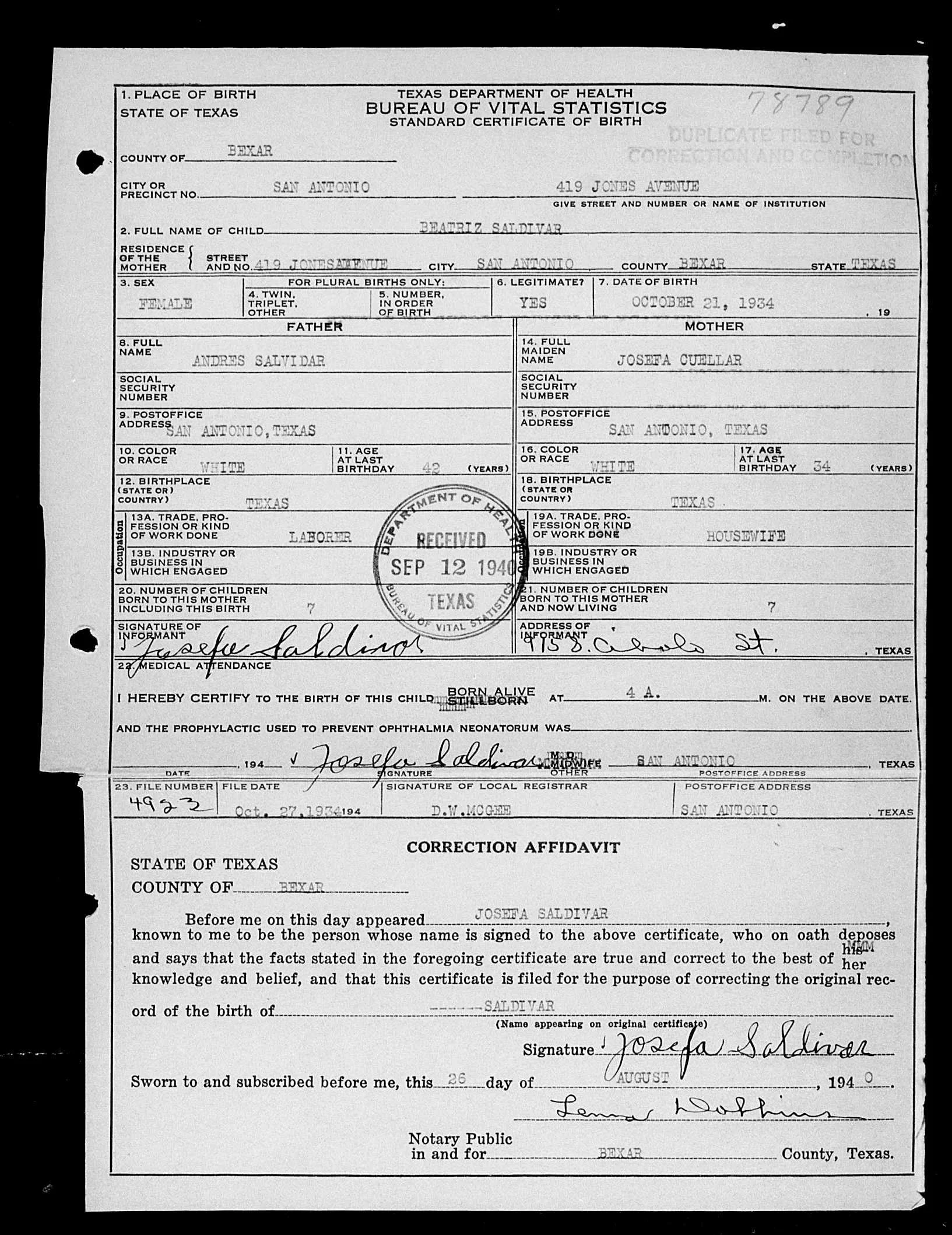
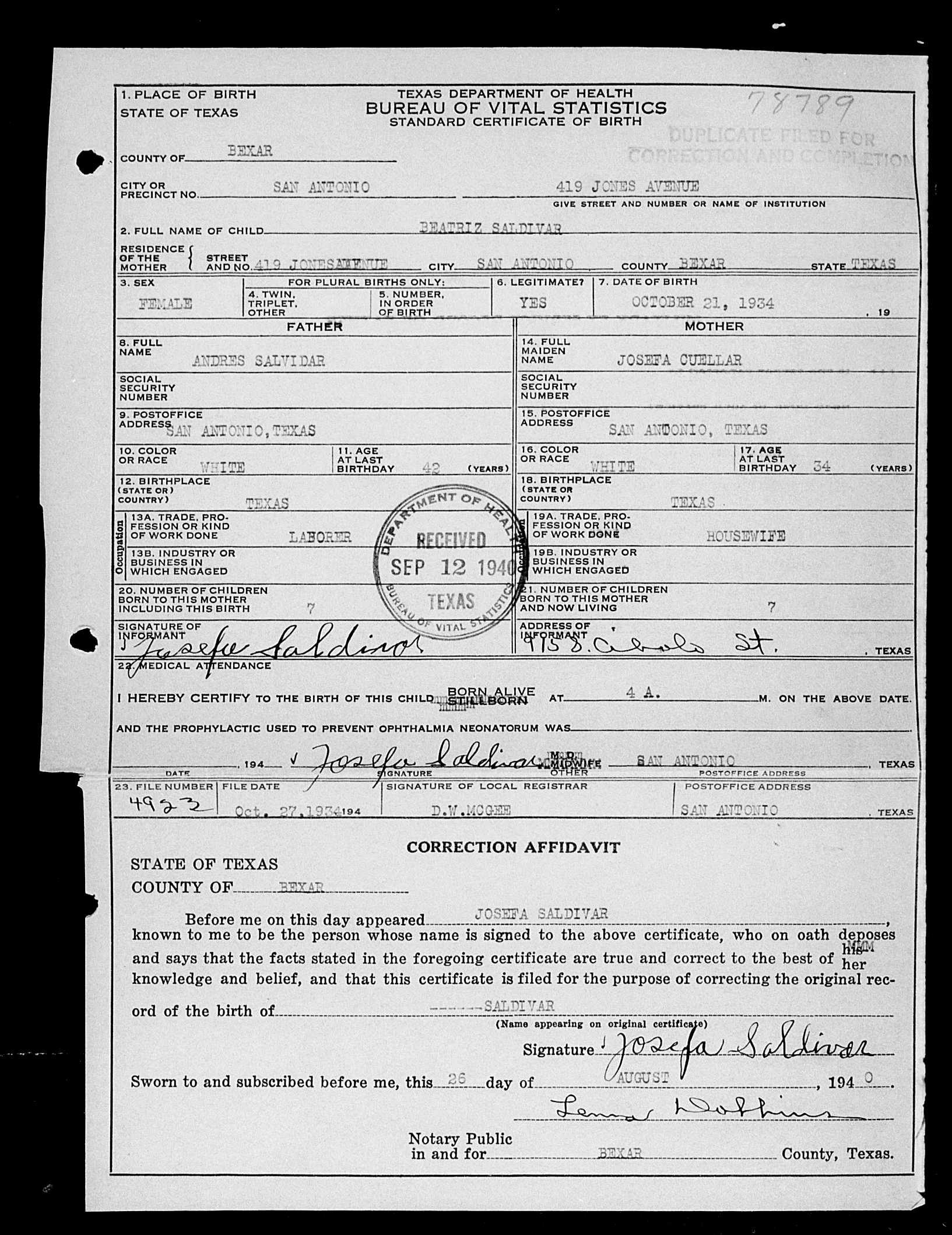
Beatrice was born in San Antonio on October 21, 1934. Her parents were Andrés Saldívar and Josefa Cuellar. She was the youngest of seven children. As a child she wanted to be a nun, but that changed when she met her future husband. On August 28, 1955, she married Gilbert Gallego, a hardware salesman. They live in the Palm Heights neighborhood at 902 W. Winnipeg and raised three children. Beatrice became active in her community very early, serving as a PTA leader, a Head Start volunteer and working at the St. James Catholic Church on Theo Avenue.
“The fruit of our labor is indeed love and grace from above,”
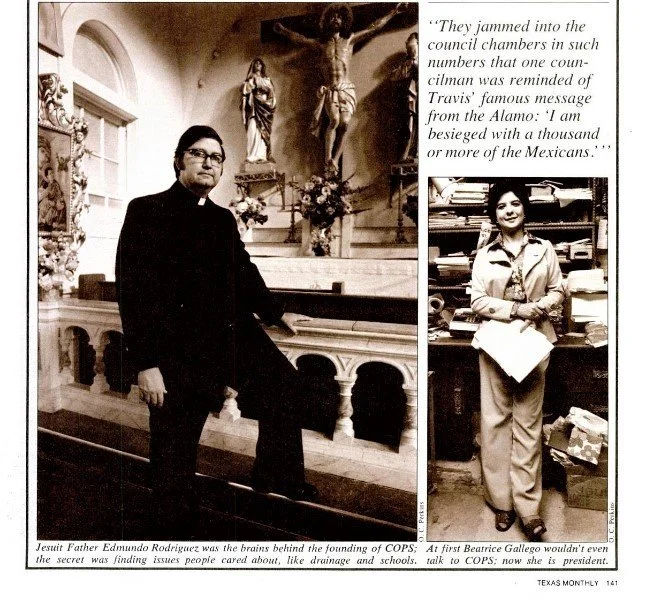
In 1974, an organization that would eventually be named Citizens Organized for Public Service (COPS) began to form in San Antonio, led by community organizer Ernesto Cortés — a Westside native trained at Saul Alinsky’s Industrial Areas Foundation in Chicago — and Father Edmundo Rodriguez of Our Lady of Guadalupe parish. Cortés had to make seventeen phone calls before Gallego would meet with him. She wasn’t interested in another march or rally. However, at the urging of a priest, she agreed, and COPS organized around neighborhood concerns: poor drainage, high utility bills, potholes, and sidewalks for children walking to school.
She remained skeptical until witnessing a COPS meeting at city hall in 1974. They had been trying to arrange a meeting with City Manager Sam Granata to discuss drainage problems; when he refused, they filled the city council chambers with five hundred people and the council ordered him to meet. Five days before that meeting, heavy rains again flooded Westside streets and collapsed a bridge over Mayberry ditch. Granata arrived at Kennedy High School to face seven hundred angry residents. When he justified the city’s inaction saying “if you want something, you have to ask for it,” Gallego knew she had to act.
“In order for any community to grow and be active, it needs to have an environment that is safe and healthy... Any community that wishes to give a better quality of life to its people needs to include libraries, not golf courses.”
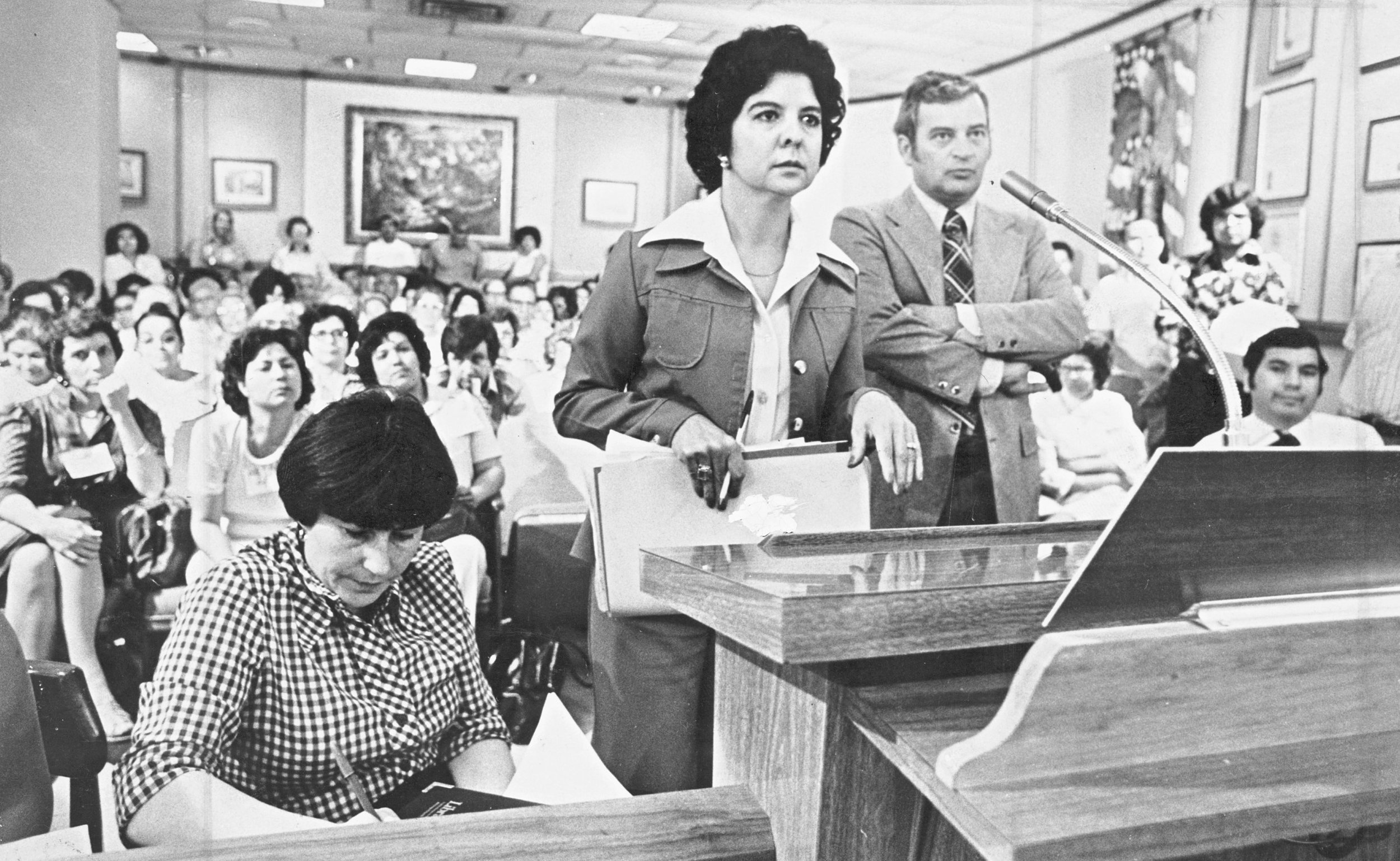
COPS was formally organized that same month after successfully pressuring the city to approve a $47 million bond package including fifteen drainage projects. Gallego became one of the most active members, co-founding a COPS chapter at St. James parish with Father Daniel Hennessy. She attended IAF training in Chicago and served as COPS Executive Vice President in 1975, successfully advocating for a pedestrian bridge over Frio City Road. In 1977 she became the second president of COPS. She and Father Benavides led the fight to force the city water board to spend $12 million replacing substandard water mains. The Nogalitos storm drainage project was completed that year. Gallego was also active in protecting the Edwards Aquifer and successfully advocated for single member city council districts — a change that transformed city politics.
“We are here today, not only to win the COPS drainage projects, but also to urge you to meet the human needs of our city.”
Gallego was also very active in COPS efforts to advocate for library branches on the West and South sides of the city — calling for installations at Nogalitos and Park, Ingram and Callahan, South Flores and March, Culebra and Santa Maria, Laredo and SW Military, Prospect Hill, and Valley Hi. She argued to the city council that libraries were sorely needed in these long-neglected neighborhoods. During her COPS leadership she continually emphasized the need for city leaders to pay attention to inner city residents rather than directing resources toward new developments on the North side of town.
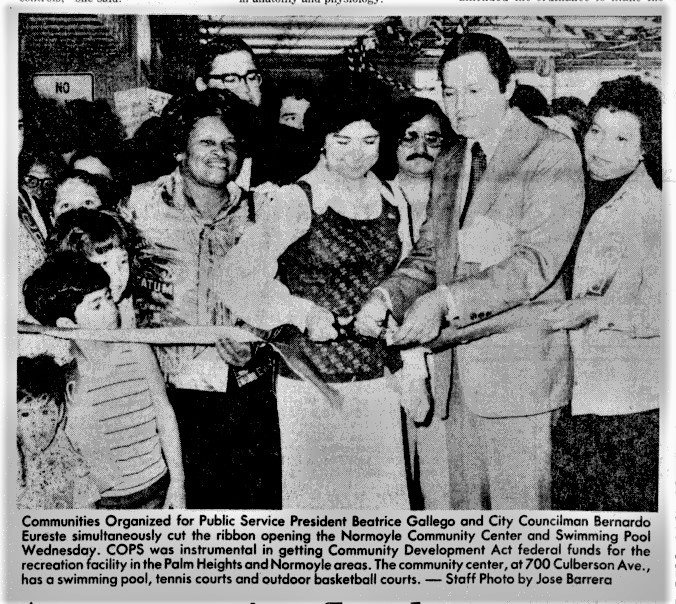
In the years after her presidency, Gallego continued to be active in the St. James COPS chapter. The Felon and Buffalo drainage projects were completed; sixty streets were improved; the Collins Garden Library, the Normoyle and Palm Heights Parks were created. A police substation and fire station were created, new bus shelters installed, and improvements were made to Lowell and Burbank schools. They worked with the St. Anthony Day Care COPS chapter to fight Kelly AFB’s request to build a storage facility for dangerous chemicals near Normoyle Park, and in 1988 played a key role in challenging the Barrett coal-burning plant due to its lack of air pollution controls. Members of St. James COPS also advocated for school finance reforms, voter turnout, the creation of Palo Alto College, after-school programs, and job training and education.
In 1996, Gallego founded the St. James Housing Trust, which oversees the El Jardin de St. James elderly housing complex at 420 Nunes, providing lighting, new screen doors, protective iron fencing, handicap accessible amenities, new chairs, tables, washers and dryers, and a nutrition program. Beatrice Gallego continues to demonstrate her love for her community through her devotion and service.
-
Acosta, Teresa Paloma and Ruthe Winegarten. Las Tejanas: 300 Years of History. Austin: University of Texas Press, 2003.
Acosta, Teresa Palomo, "LA MUJER MODERNA," accessed July 20, 2020, http://www.tshaonline.org/handbook/online/articles/eel09. Uploaded on June 15, 2010. Published by the Texas State Historical Association.
Blackwell, Maylei. ¡Chicana Power! Contested Histories of Feminism in the Chicano Movement. Austin: University of Texas Press, 2011.
Chacón, Justin Akers. “Magonismo and the roots of revolutionary internationalism.” International Socialist Review, Issue 101.
https://isreview.org/issue/101/magonismo-and-roots-revolutionary-internationalism/index.html
Kanellos, Nicolás. American Latino Theme Study: Intellectual Traditions: Envisioning and Re-visioning the Nation: Latino Intellectual Traditions. National Park Service. https://www.nps.gov/articles/latinothemeintellectual.htm)
Lemus, Gustavo Mendoza. “Andrea Villarreal, el rescate de la poeta revolucionaria.” Milenio. Monterrey, Mexico. August 23, 2019.https://www.milenio.com/cultura/historiadora-presenta-su-libro-revolucionarios-en-el-exilio
Lomas, Clara, “Discurso transfronterizo. La articulación del género en la frontera en los primeros años del siglo XX”, en Dimensión Antropológica, vol. 25, mayo-agosto, 2002, pp. 91-116. Disponible en:http://www.dimensionantropologica.inah.gob.mx/?p=828
Magón, Ricardo Flores. “A la mujer” quoted in Martha P. Cotera, Diosa y Hembra: The History and Heritage of Chicanas in the U.S. (Austin: Information Systems Development, 1976), 67.
Marino, Katherine M. “The International History of the U.S. Suffrage Movement.” Origins: Current Events in Historical Perspective. Vol 13, Issue 7, April 2020.
http://origins.osu.edu/article/19th-amendment-suffrage-women-vote
McArthur, Judith N. and Harold L. Smith. Texas Through Women’s Eyes: The Twentieth-Century Experience. Austin, University of Texas Press, 2010.
The Missoulian, March 19, 1911.
“El Partido Anti-Reeleccionista.”El Obrero, San Antonio, Texas. December 15, 1910.
Pérez, Emma. The Decolonial Imaginary: Writing Chicanas into History. Bloomington: Indiana University Press, 1999.
“¡Pueblo Rebelde, Adelante!” El Progreso, San Antonio, Texas, November 1908.
Raat, William Dirk. “The Diplomacy of Suppression: Los Revoltosos, Mexico, and the United States, 1906-1911.” Hispanic American Historical Review (1976) 56 (4): 529–550. November 1, 1976.
Regeneración, Los Angeles, California. January 21, 1911.
Regeneración, Los Angeles, California. February 25, 1911.
St. Louis Dispatch, St. Louis, Missouri. September 10, 1905.
“Mexicans Brought here for Trial.” St. Louis Dispatch, St. Louis, Missouri. November 22, 1906.
St. Louis Republic, St. Louis, Missouri. November 19, 1906.
“Women will Plead Cause of Refugees,” San Antonio Light and Gazette, August 18, 1909, p.1.
Zárate, Griselda.“Dos Hermanas Revolucionarias: Andrea y Teresa Villarreal.” Bicentenario: El Ayer y Hoy in Mexico. Instituto Mora. Vol 3, No. 10, 2010.
https://www.institutomora.edu.mx/Documentos/BiC-10RevistaCompleta2.pdf