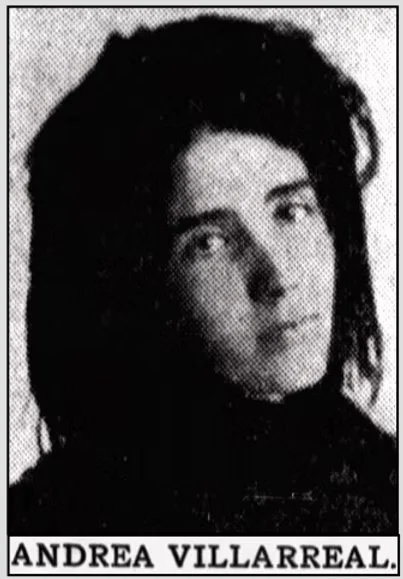
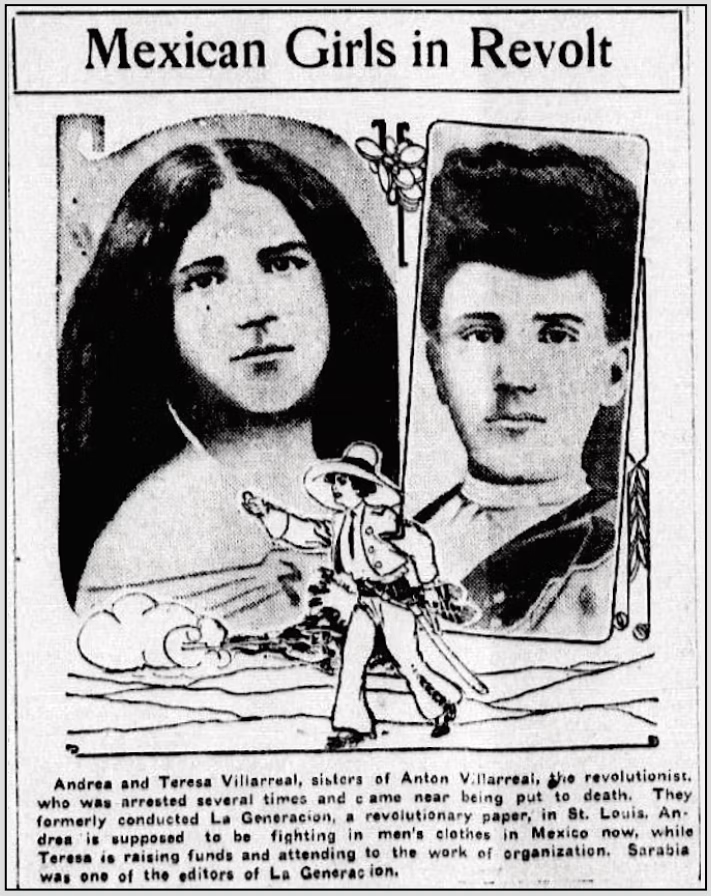
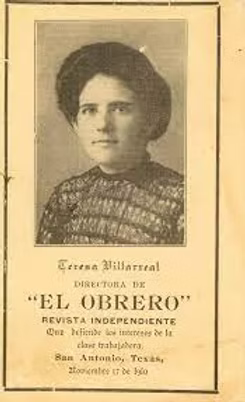
Andrea Villarreal González and Teresa Villarreal González
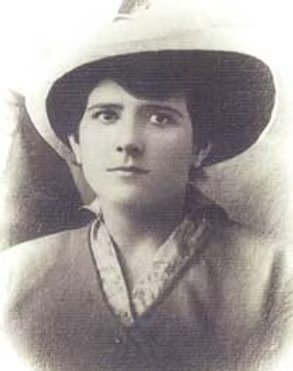
“It is now time for woman to become independent and for men to stop considering themselves the center of the universe and to stop oppressing her and to give her in daily life the position of comadre and companion that corresponds to her.”
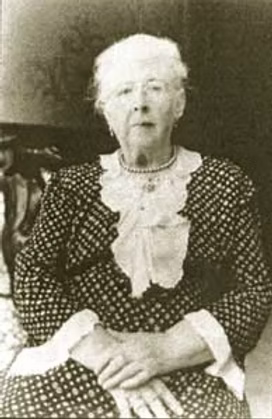
-
Acosta, Teresa Paloma and Ruthe Winegarten. Las Tejanas: 300 Years of History. Austin: University of Texas Press, 2003.
Acosta, Teresa Palomo, "LA MUJER MODERNA," accessed July 20, 2020, http://www.tshaonline.org/handbook/online/articles/eel09. Uploaded on June 15, 2010. Published by the Texas State Historical Association.
Blackwell, Maylei. ¡Chicana Power! Contested Histories of Feminism in the Chicano Movement. Austin: University of Texas Press, 2011.
Chacón, Justin Akers. “Magonismo and the roots of revolutionary internationalism.” International Socialist Review, Issue 101.
https://isreview.org/issue/101/magonismo-and-roots-revolutionary-internationalism/index.html
Kanellos, Nicolás. American Latino Theme Study: Intellectual Traditions: Envisioning and Re-visioning the Nation: Latino Intellectual Traditions. National Park Service. https://www.nps.gov/articles/latinothemeintellectual.htm)
Lemus, Gustavo Mendoza. “Andrea Villarreal, el rescate de la poeta revolucionaria.” Milenio. Monterrey, Mexico. August 23, 2019.https://www.milenio.com/cultura/historiadora-presenta-su-libro-revolucionarios-en-el-exilio
Lomas, Clara, “Discurso transfronterizo. La articulación del género en la frontera en los primeros años del siglo XX”, en Dimensión Antropológica, vol. 25, mayo-agosto, 2002, pp. 91-116. Disponible en:http://www.dimensionantropologica.inah.gob.mx/?p=828
Magón, Ricardo Flores. “A la mujer” quoted in Martha P. Cotera, Diosa y Hembra: The History and Heritage of Chicanas in the U.S. (Austin: Information Systems Development, 1976), 67.
Marino, Katherine M. “The International History of the U.S. Suffrage Movement.” Origins: Current Events in Historical Perspective. Vol 13, Issue 7, April 2020.
http://origins.osu.edu/article/19th-amendment-suffrage-women-vote
McArthur, Judith N. and Harold L. Smith. Texas Through Women’s Eyes: The Twentieth-Century Experience. Austin, University of Texas Press, 2010.
The Missoulian, March 19, 1911.
“El Partido Anti-Reeleccionista.”El Obrero, San Antonio, Texas. December 15, 1910.
Pérez, Emma. The Decolonial Imaginary: Writing Chicanas into History. Bloomington: Indiana University Press, 1999.
“¡Pueblo Rebelde, Adelante!” El Progreso, San Antonio, Texas, November 1908.
Raat, William Dirk. “The Diplomacy of Suppression: Los Revoltosos, Mexico, and the United States, 1906-1911.” Hispanic American Historical Review (1976) 56 (4): 529–550. November 1, 1976.
Regeneración, Los Angeles, California. January 21, 1911.
Regeneración, Los Angeles, California. February 25, 1911.
St. Louis Dispatch, St. Louis, Missouri. September 10, 1905.
“Mexicans Brought here for Trial.” St. Louis Dispatch, St. Louis, Missouri. November 22, 1906.
St. Louis Republic, St. Louis, Missouri. November 19, 1906.
“Women will Plead Cause of Refugees,” San Antonio Light and Gazette, August 18, 1909, p.1.
Zárate, Griselda.“Dos Hermanas Revolucionarias: Andrea y Teresa Villarreal.” Bicentenario: El Ayer y Hoy in Mexico. Instituto Mora. Vol 3, No. 10, 2010.
https://www.institutomora.edu.mx/Documentos/BiC-10RevistaCompleta2.pdf
Labor and Women's Rights Activists
1881-1963,
1883-1949
Journalists Teresa and Andrea Villarreal González lived in San Antonio only briefly as political exiles. However, their work reflected the importance of the city’s westside as a center of organizing for the Mexican revolution. Their work also demonstrates the close connection between this political movement and the struggle for workers’ rights and women’s liberation.
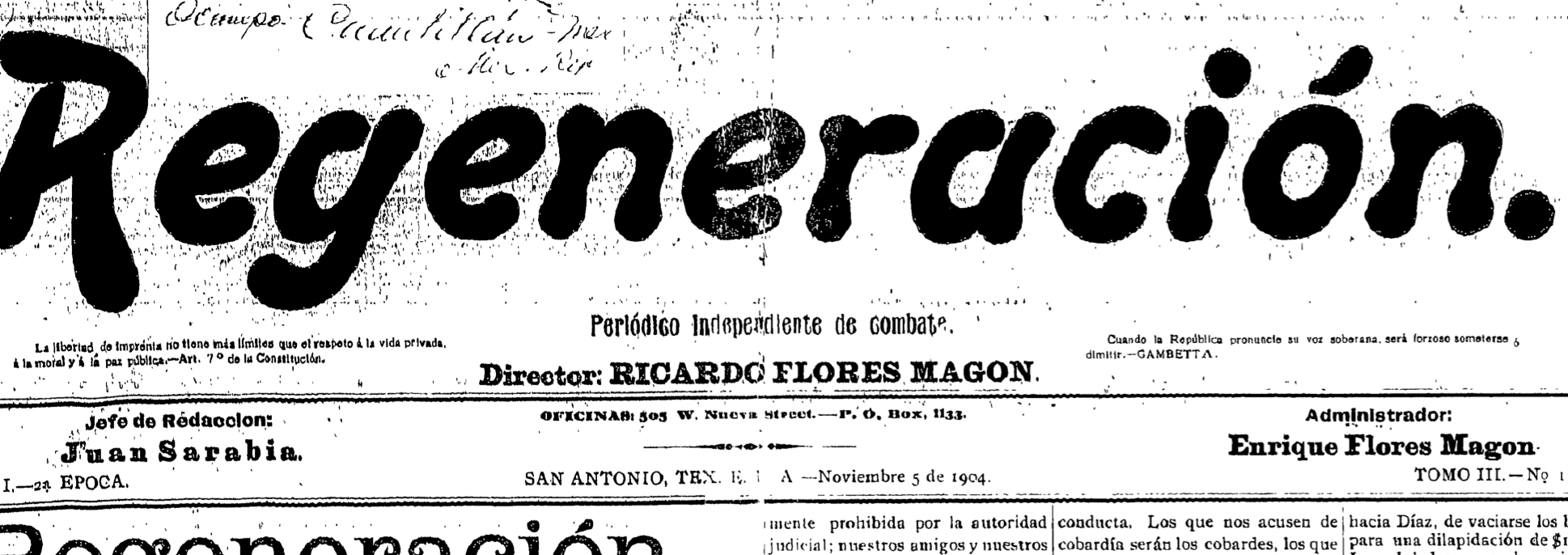
Teresa and Andrea were born in Lampazos, Nuevo León. Their father, Próspero Villarreal Zuazua, helped found the Sociedad de Obreros de Lampazos in 1887, an organization that addressed labor issues. Their family, including their brothers Próspero, Antonio and Alfonso, was part of a political reform movement in opposition to dictator Porfirio Díaz. One of these reform groups, called El Club Liberal de Lampazos, was forced to close and its leaders were incarcerated. This forced the family to flee to the United States in 1904. They became part of a group of exiles associated with brothers Enrique and Ricardo Flores Magón, who had also relocated to San Antonio that year. Sometimes called “magonistas,” this group sought to overthrow Díaz. Beginning in 1900, the Magón brothers published a newspaper called Regeneración in Mexico City, where they reported on the abuses of the Díaz regime. When the Magón brothers moved to San Antonio, the newspaper resumed publication at 505 W. Nueva Street. The magonistas also supported women’s liberation. Ricardo Flores Magón wrote a special message to women, noting that they were degraded by the chains of tradition and exploited as cheap labor. Andrea and Teresa were part of a group of women in Texas, including Sara Estela Ramírez and Isidra T. de Cárdenas, who defended women’s equality along with the broader goals of the revolutionary movement.They formed several of their own clubs. In San Antonio, Andrea and Teresa raised funds and organized activities with El Club Liberal de Señoras y Señoritas, Leona Vicaro y Antonio Nava.
After a Mexican agent attempted to assassinate one of the Magón brothers they relocated to St. Louis, Missouri in 1905, joined by the Villarreals. In St. Louis they reorganized as the “Organizing Junta of the Mexican Liberal Party (PLM),” and became part of a multi-national community of political refugees, many of whom came after the city hosted the World’s Fair. In an article on September 10, 1905, the St. Louis Dispatch described this group of Chinese, Polish, Irish, German, Turkish, Spanish and Latin American political refugees. The magonistas created a party platform and revolutionary manifesto that distinguished themselves from other more moderate members of the PLM. Antonio Villarrreal served as the Secretary of the party. They continued to distribute Regeneración to subscribers throughout Mexico and the U.S. borderlands.
The next year many magonistas were forced to flee again. Antonio, Ricardo Flores Magón and Librado Rivera were arrested by immigration authorities. Teresa and Andrea began an intensive campaign for their defense, writing letters to newspapers and lawyers. On November 19, 1906, the sisters wrote in the St. Louis Republic, saying they were seeking justice. That same month the St. Louis Dispatch published the sisters’ photographs in an article “Mexican Women Who Are Fighting the Government.” On November 22, 1906, the St. Louis Dispatch published another article about the arrest of Librado Rivera. The article quoted Andrea as a spokesperson for the movement. Andrea said they would not return to Mexico because “we can’t speak the truth.” She defended Rivera, who was being pursued by the Mexican government on charges of robbery and murder. “He never murdered anyone. When he was in Mexico he was a quiet school teacher. All they want is to get him back to Mexico, where they will imprison him for a long time, as they have imprisoned other members of the junta.” Andrea also noted that they wanted to stay in the United States in the hopes of getting a fair trial.
The group managed to jump bond, but were re-captured in Los Angeles on August 23, 1907, by the Furlong Detective Agency on behalf of the Mexican government. They were charged with violating the U.S. neutrality laws and conspiring to begin a military expedition against the Mexican government. Several months later they were transferred to Tombstone, Arizona, to await trial. Andrea continued to advocate for their release through the press, and to defend the revolutionaries’ cause. The Evening Star (Washington DC) on October 19, 1907 quotes her as saying “it is natural that we are exiled now, because we defended our rights and fought for the good of the laboring classes who need our aid so much. Our people are oppressed, they work for a few cents a day and live in poverty and dirt. How can they ever be good citizens unless their conditions of life are changed. In thirty years of this so-called Mexican peace we have seen more dead people than thirty years of war could destroy. I love the revolution better than the peace which has cost Mexico so much.” In this article Andrea also explicitly challenged the racist depictions of Mexican revolutionaries: “Some charge that we are agitators because of our Indian blood. But the great Juárez, our best president, was an Indian. It was he who wrote the constitution of Mexico, which Díaz is tramping every day.” Andrea also participated in an armed uprising on June 26, 1908, in Las Vacas, Coahuila. She helped supply weapons and ammunition for the rebellion. But she was most well known for her speeches and writings. Andrea continued to contribute to other publications like Reforma, Libertad y Justicia, published in McAlester, Oklahoma, where she published an article in September 1908 called “¡Pueblo Rebelde, Adelante!”, and published this same article in El Progreso in San Antonio in November of that year.
At this point Andrea and Teresa were reestablishing themselves in San Antonio, and would continue to publish their work from here for the next three years. On August 18, 1909, The San Antonio Light called Andrea the Mexican Joan of Arc after she joined labor activist MotherJones at one of the “freedom meetings” at the tent theater on East Houston Street (though Andrea personally rejected this title). Many U.S. labor organizers continued their support of the Mexican revolutionaries, including Socialist Party presidential candidate Eugene V. Debs. In the newspaper Appeal to Reason, Debs wrote an editorial called “Rescue the Refugees” and called for the release of their brother Antonio and other magonistas. Andrea translated this article into Spanish for the newspaper La Estrella, published in San Antonio in 1909. Andrea also published her poetry, including “Por senderos de Gloria [Along paths of Glory]” and “El Sitio de Cuautla [the Site of Cuautla],” in La Estrella.
“Mujeres somos; pero no hemos sentido flaquezas que nos empujen a abandonar la pelea. Mientras más punzante era el dolor que nos hería, más se acrecentaba el cariño que profesamos a la causa de la libertad.”
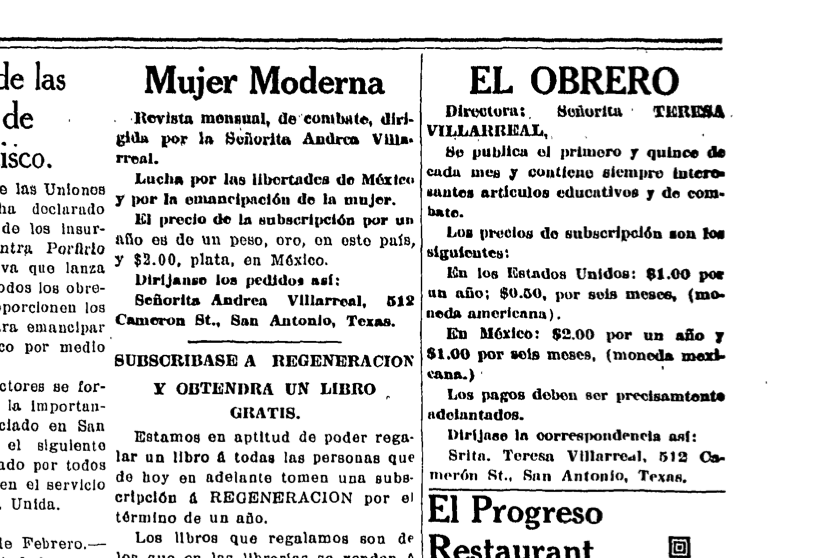
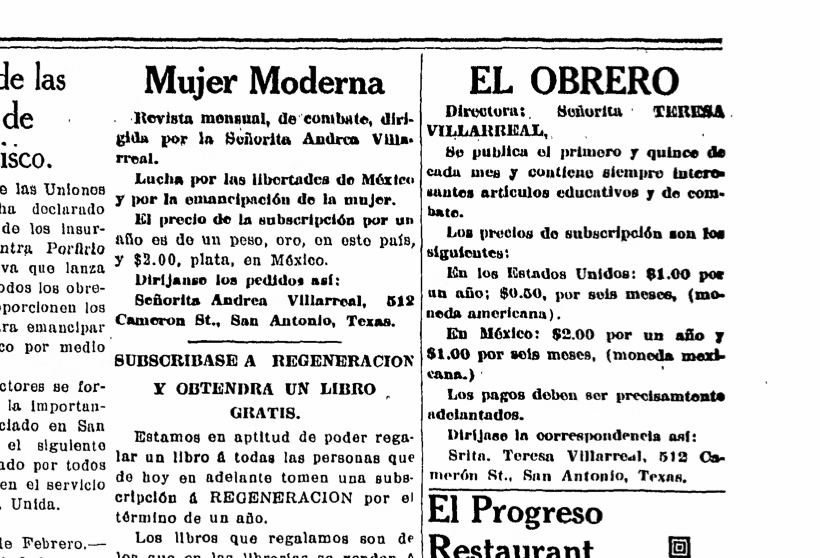
Andrea and Teresa also founded their own publications in San Antonio. Andrea created La Mujer Moderna, a newspaper dedicated to women’s rights, in December of 1909. This was one of Texas’ first feminist newspapers. One of Andrea’s articles was titled “A Qué Venimos [What we are coming to]" The newspaper addressed the rights of Mexican migrants and called for woman suffrage.
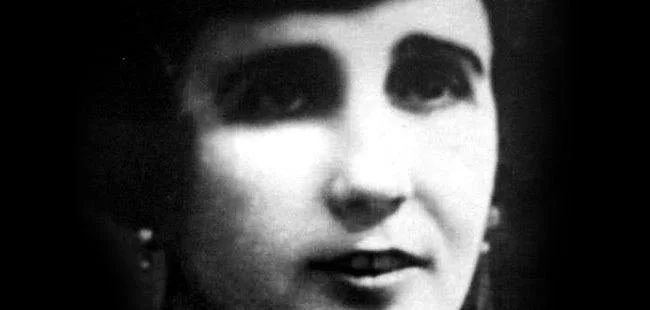
Teresa founded El Obrero in 1910. In this newspaper she wrote an article that supported Francisco Madero’s new Anti-Reelectionist Party. Madero was a wealthy landowner and reformist who had been leading his own opposition movement against Díaz, challenging his attempt to run for president again. In 1910, Madero was imprisoned, but escaped to San Antonio the following year. From here Madero issued the Plan of San Luis Potosí, which called for an armed uprising against Díaz, and outlined his own program of reform. Teresa’s article, called “El Partido Anti-Reeleccionista” was published in December 1910. In it she told a story about one of the first incidents that triggered the Mexican Revolution in the city of Puebla, where the Serdán family defended themselves against arrest. When the Chief of Police Miguel Cabrera tried to arrest them, they fought back, and killed Cabrera in self defense. The official account credited Aquiles Serdán as the person who fired the fatal shot, but Teresa noted in her article that a woman was actually responsible for killing Cabrera. “Una mujer, sin tener las fuerzas del hombre, pero de un alma viril y heroica mató al jefe de la policía, a Miguel Cabrera, el hombre degenerado que cometía crímenes para obedecer las órdenes de un gobierno despótico [A woman, without having the strength of a man, but with a virile and heroic soul, killed the police chief, Miguel Cabrera, the degenerate man who committed crimes to obey the orders of a despotic government].” In her chronicling of the events, Teresa puts women at the center of the struggle to liberate Mexico. In the second part of her article, Villarreal urges PLM members to support the Anti-Reelectionist Party in order to build an effective force against the dictatorship:
“Debemos aspirar al mejoramiento económico de las masas si queremos que México figure como un pueblo culto entre las naciones del mundo civilizado. Esa debe ser la aspiración que nos aliente a todos en la lucha contra la Dictadura actual. Luchemos en pro de la civilización y el adelanto moral y material del proletariado mexicano. [We must aspire to the economic improvement of the masses if we want Mexico to appear as a cultured people among the nations of the civilized world. That should be the aspiration that encourages us all in the fight against thecurrent dictatorship. Let us fight for civilization and the moral and material advancement of the Mexican proletariat.]”
Both Andrea and Teresa also continued to write for Regeneración and other publications in support of the ongoing Mexican Revolution. On January 21, 1911, Andrea and Teresa co-wrote an article called “¿Qué hacéis aquí hombres? Volad, volad al campo de batalla [What are you doing here men? Fly, fly to the battlefield.]”. The next month Regeneración also published information about a new women’s organization in San Antonio, led by Teresa Villarreal, which specifically called for the revolution to liberate women. They called for the revolution to recognize women as comrades and companions in the struggle to liberate Mexico.
Meanwhile, their brother Antonio and other leaders of the movement were found guilty of conspiracy to violate neutrality laws and were sentenced to eighteen months in prison. They were released in August 1910. At this point, Ricardo Flores Magón once again resumed publication of Regeneración in Los Angeles and started plans for a revolt in Baja California. On January 29, 1911 the PLM took over Tijuana and Mexicali, and held these territories for six months. However, tensions increased between the magonistas and others who opposed Díaz. The PLM called for a revolution that abolished property and created an anarchist worker’s commune, while Madero’s supporters called for democratic reforms that did not significantly challenge landowner interests, and were more friendly to the United States. Madero tried to bring the magonistas to his side, but Ricardo Flores Magón rejected him, noting he was part of a “revolution of the rich.” On February 25, 1911, the front page headline of Regeneración read “Francisco I. Madero es un Traidor de la Causa de la Libertad [Francisco I. Madero is a traitor to the cause of liberty.]” The Villarreal family, however, joined with Madero and split with the Magóns. In that same issue of Regeneración Magón declared that Antonio Villarreal was no longer a member of the PLM, as he had joined the Progressive Constitutionalist Party (PCP) of Francisco Madero. Later that year, the Baja revolt collapsed and the Magón brothers were arrested again.
When Antonio left the United States to join President Madero’s new administration, Andrea and Teresa joined him to live in Mexico City. They continued to advocate for women’s rights within Mexico. In November 1911 Andrea and other recently returned women exiles wrote an article called “La mujer mexicana surge á la vida del progreso. Se funda una importante agrupación” for El Diario del hogar, which announced a new organization called Club Femenil Sufragista that would petition Madero to give women the right to vote. Although Madero and several other prominent revolutionary leaders supported women’s rights, Mexico did not grant women the right to vote until 1953.
Andrea and Teresa lived in Mexico for the rest of their lives. Less is known about Teresa’s life after the revolution. She died in 1949. Andrea was married and had a child, but both her husband and her daughter died shortly after their marriage. In 1951, Andrea wrote a letter to Mexico’s Secretary of Defense petitioning the government to honor her as a veteran of the Mexican Revolution, noting her participation in the armed revolt in Las Vacas, Coahuila and her many articles in support of the revolution both in Mexico and the United States. She never received this recognition. Andrea died in Monterrey in 1963.